Most small and mid-sized businesses do not have a procurement problem. They have a procurement chaos problem. Purchases happen through WhatsApp messages to suppliers, invoices arrive without anyone knowing what was ordered, and the stock count is whatever someone last wrote on a whiteboard in the warehouse. When a supplier dispute surfaces — wrong quantity delivered, wrong price charged — there is no purchase order to refer to and no goods receipt record to check.
This is not a failure of the people involved. It is a failure of the process, or more accurately, the absence of one. Procurement management software replaces the ad hoc purchasing habits that work fine at low volume and break down as the business grows — with a structured, auditable workflow that protects your budget, your supplier relationships, and your inventory accuracy.
This guide covers every stage of the procurement cycle — from supplier management through purchase orders, goods receipt, and inventory updates — and explains how BYDCRM Procurement addresses each one without requiring enterprise-level complexity.
Who this is for: Operations managers, procurement teams, manufacturing businesses, and retail or wholesale SMBs that are currently managing purchasing through spreadsheets, emails, or no formal process at all — and are starting to feel the pain.
Why Procurement Without Software Costs More Than You Think
The visible cost of informal procurement is the occasional duplicate order or the supplier invoice that nobody can reconcile. The invisible cost is larger and accumulates quietly across every purchase the business makes.
Maverick Spending: The Budget Leak Nobody Tracks
Maverick spending is any purchase made outside an approved process — a staff member calling a supplier directly, a manager approving a spend verbally, an invoice arriving that nobody in accounts recognises. Without purchase orders as a control point, maverick spending is invisible until month-end when the bank statement makes it visible. By that point, the goods are already in the building and the supplier expects payment.
Supplier Disputes Without Evidence
When a supplier delivers 80 units but invoices for 100, you need two things to dispute it credibly: the original purchase order showing what was ordered, and a goods receipt note showing what was actually received. Without both, you are negotiating based on memory versus a printed invoice — and you will usually lose.
Inventory That Nobody Trusts
When stock levels are updated manually — or not at all — the inventory system becomes a historical record rather than an operational tool. Purchasing decisions made on inaccurate stock counts lead to over-ordering (capital tied up in excess stock) or under-ordering (production halts and emergency purchases at unfavourable prices).
The Procurement Cycle: From Need to Payment
A structured procurement cycle transforms purchasing from a series of ad hoc transactions into a controlled, repeatable process. BYDCRM Procurement follows this flow:
Each step creates a documented record. Each record links to the previous one. By the time the supplier invoice arrives, you have a chain of evidence — quote, PO, GRN — that makes three-way matching straightforward and disputes easy to resolve.
Supplier Management: More Than Just a Contact Book
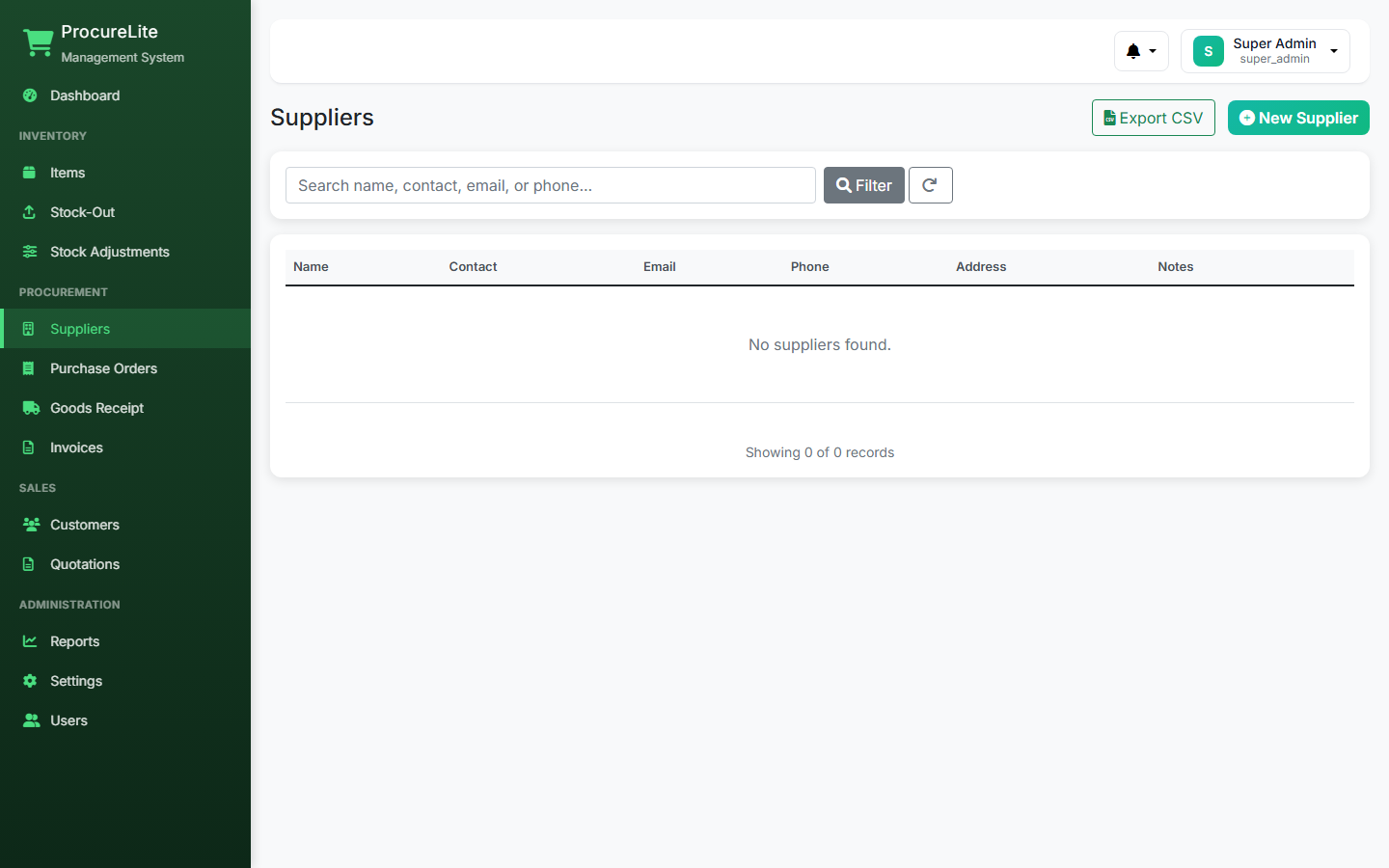
The supplier database in BYDCRM Procurement is designed around the information that actually matters for purchasing decisions — not just a name and phone number.
Structured Supplier Profiles
Each supplier record stores contact details, product categories they supply, standard payment terms, and their full order history. When you need to reorder from a supplier you haven't used in six months, the last order quantity, price, and lead time are all visible in their profile — so you're negotiating with data, not guesswork.
Quotation Comparison
For any given purchase, you can record quotes from multiple suppliers and compare them side by side — price, lead time, and terms. When you select the preferred quote, BYDCRM Procurement converts it to a purchase order automatically, carrying across all line items, quantities, and agreed prices. No re-keying, no transcription errors.
Supplier Performance Visibility
Over time, the system builds a purchase history per supplier that lets you evaluate on-time delivery, invoice accuracy, and order frequency. This data is leverage in supplier negotiations — you know which suppliers you depend on, which ones regularly deliver short, and which ones consistently add value.
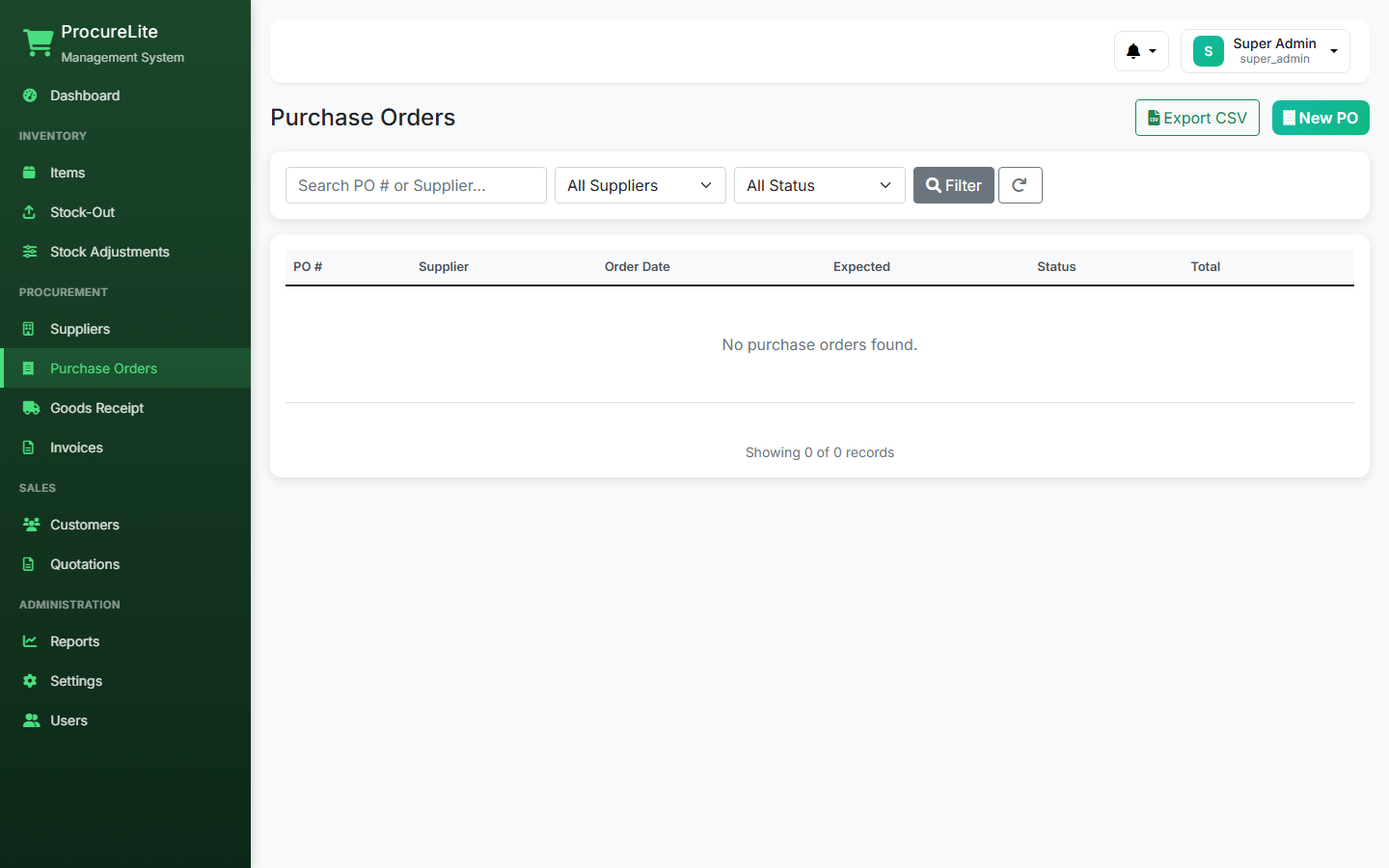
Purchase Orders: The Control Point That Protects Your Budget
The purchase order is the single most important document in procurement. It is a formal commitment to buy, at an agreed price, for an agreed quantity — and it creates the legal and operational basis for everything that follows.
Auto-Numbered PO Reference System
Every purchase order in BYDCRM Procurement receives a sequential auto-number in the format PO-XXXXX. This numbering is tamper-proof and gap-free — every PO ever raised is in the system, with its status, value, and linked documents. Auditors, accountants, and managers can trace any purchase from PO number to payment in seconds.
Draft to Approval Workflow
POs begin in draft status, where line items, quantities, and prices can be edited freely. When submitted for approval, a notification goes to the designated approver — typically a manager or accounts lead. Only after approval does the PO become a confirmed order and the supplier receives any communication. This approval gate is where maverick spending is stopped before it becomes a committed liability.
Multi-Line Item POs with Full Detail
Each PO can carry multiple line items — item name, SKU, unit, quantity ordered, unit price, and line total. Discounts and freight charges can be added at the PO level. The total order value is calculated automatically, and the PO PDF carries all the information a supplier needs to fulfil the order correctly.
Notification on submission: When a staff member submits a PO for approval, the designated admin or manager receives an in-system notification immediately. No PO sits in a queue unseen — the approval workflow has a clear owner and a timestamp.
GRN and Auto Stock Updates: Closing the Loop
The goods receipt note is the step that most businesses without procurement software skip entirely — and it is the step that causes the most downstream problems.
What a GRN Records
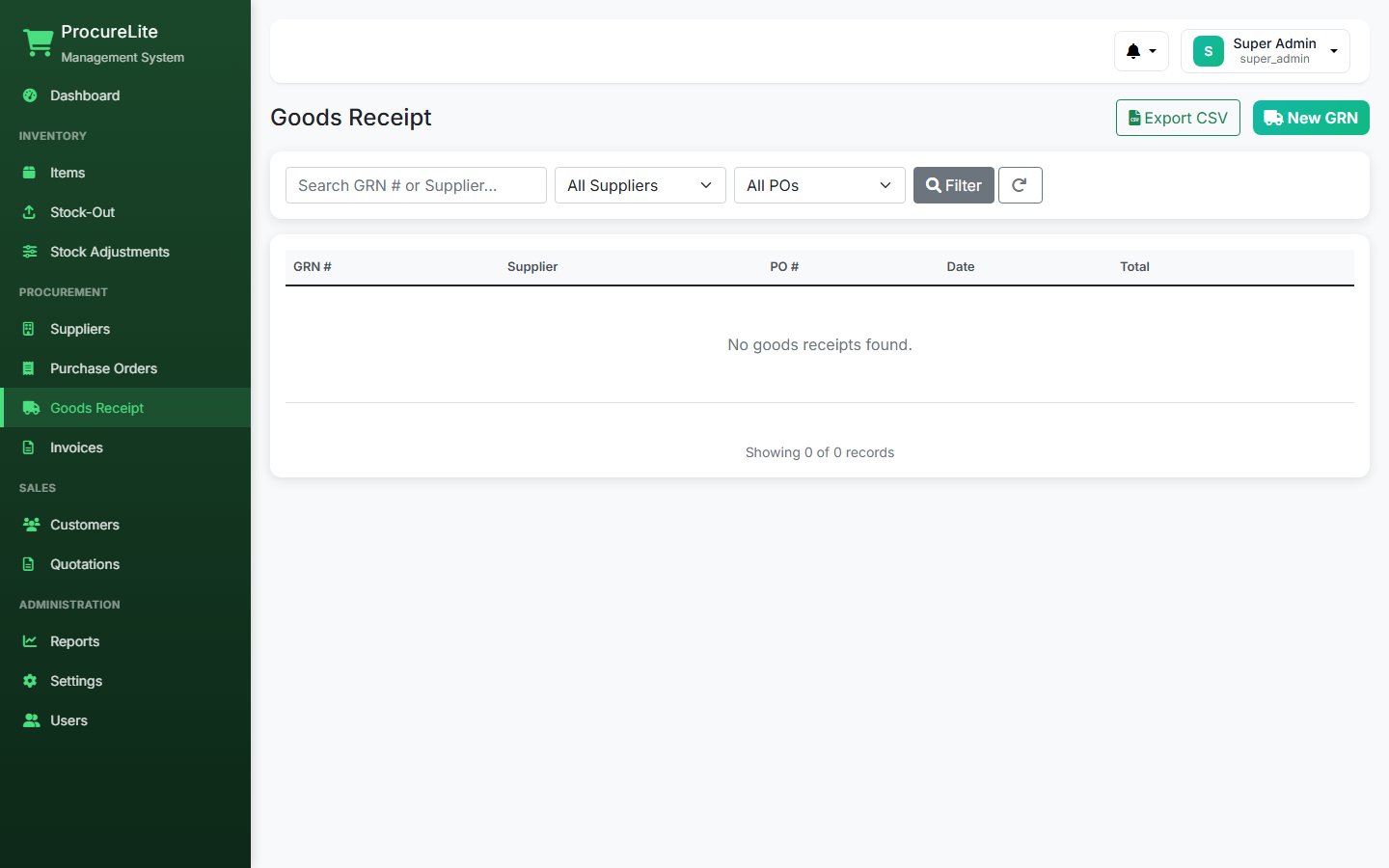
A GRN captures what was physically received — which may differ from what was ordered. Supplier delivered 95 units instead of 100? The GRN records 95. Wrong item substituted? The GRN notes the discrepancy. This receipt record, timestamped and signed off, is the evidence you need to reconcile against the supplier invoice and dispute any shortfall.
Linked to PO or Standalone
GRNs in BYDCRM Procurement can be raised directly against an existing purchase order — pulling through the supplier, items, and expected quantities — or created as standalone receipts for unplanned deliveries. Both types carry the same auto-numbered GRN-XXXXX reference and appear in the full movement log.
Automatic Stock Increment on Confirmation
When a GRN is confirmed, the system automatically increments the stock level for each received item by the quantity recorded on the GRN. This update happens immediately and is reflected in the inventory dashboard in real time. There is no manual stock adjustment step, no batch update, no end-of-day sync — the warehouse count and the system count stay aligned because every receipt is logged at the point of receipt.
Inventory Visibility: Never Run Out (or Over-Order) Again
Procurement and inventory are two sides of the same control problem. Procurement determines what enters stock; inventory management determines when to reorder. BYDCRM Procurement handles both in one system.
Reorder Points and Low-Stock Alerts
Each item in the catalogue can be assigned a reorder point — the stock level at which a new purchase order should be initiated. When a GRN confirmation or an outbound movement drops an item's stock below its reorder point, BYDCRM Procurement flags it with a low-stock alert. You see the alert before you run out, not after a customer order fails because the item is unavailable.
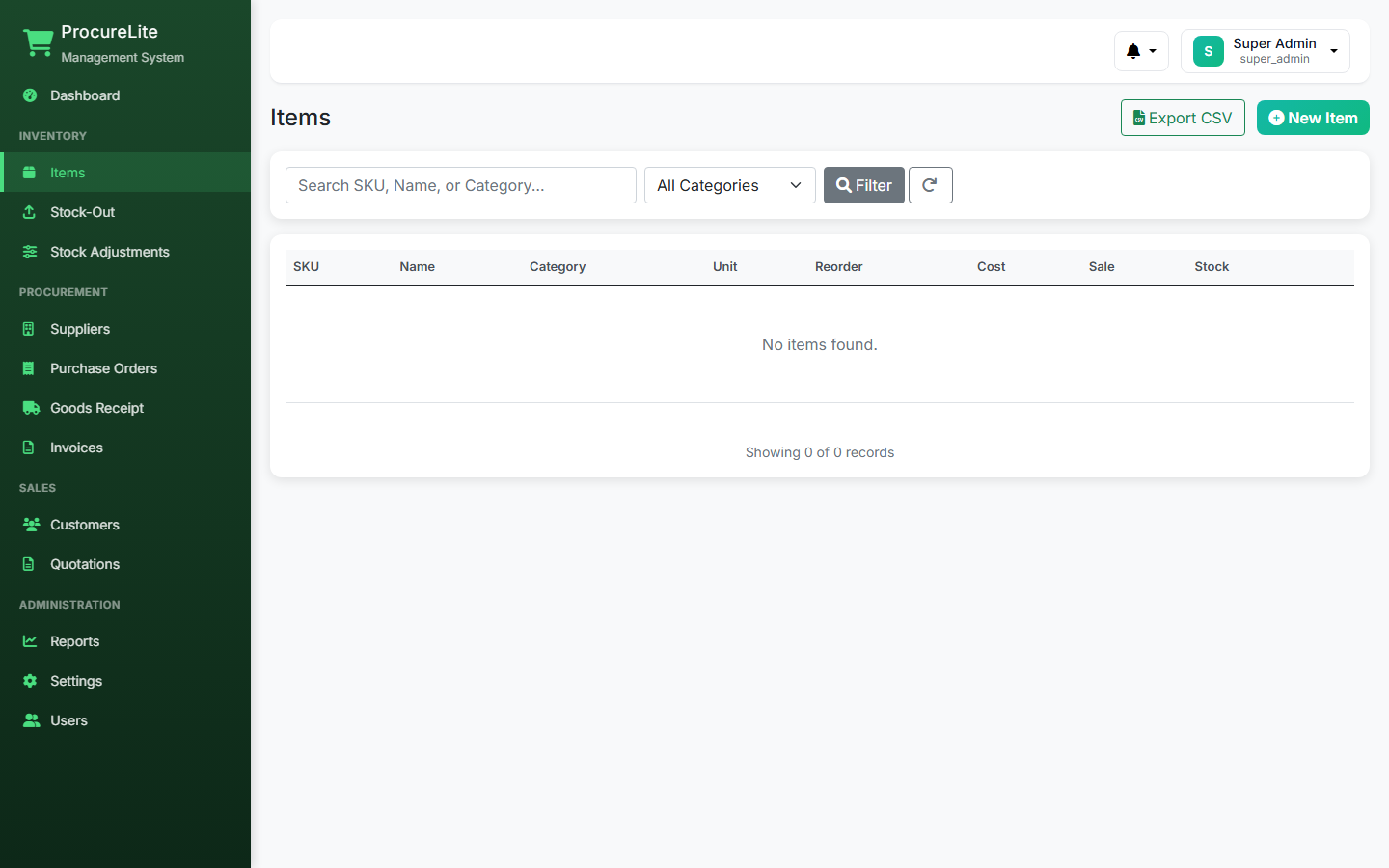
SKU and Category Management
Items are organised by category and SKU for fast filtering. Whether you manage 50 items or 5,000, the catalogue structure keeps inventory searchable and the stock reports readable. Current stock level, reorder point, and unit cost are visible per item without running a report.
Stock Valuation
The inventory module calculates the current value of stock on hand — quantity multiplied by unit cost — at any point in time. This valuation is essential for balance sheet reporting, insurance purposes, and understanding how much working capital is tied up in inventory at any given moment.
How BYDCRM Procurement Fits SMB Operations
BYDCRM Procurement is built on the principle that procurement structure should not require an ERP implementation budget. It runs on PHP/MySQL — deployable on standard hosting without enterprise infrastructure — and covers the complete procurement cycle in a single system:
- Supplier database with category, payment terms, and full order history
- Quotation recording and side-by-side comparison with PO conversion
- Auto-numbered purchase orders with draft-to-approval workflow and admin notification
- Goods receipt notes linked to POs with auto stock increment on confirmation
- Item catalogue with SKU, reorder points, and real-time low-stock alerts
- Stock movement log with full audit trail for every inbound and outbound movement
- Purchase history reports and supplier performance tracking
There are no per-seat licensing fees, no module upgrades required, and no data locked behind a proprietary cloud platform. Your procurement data stays in your database, exportable and portable.
The ROI of Procurement Software
The return on investment for procurement software is rarely a single dramatic saving. It is the accumulation of many smaller efficiencies and risk reductions that compound over time.
Time Savings
Creating a PO from a saved supplier template takes under two minutes. Raising a GRN linked to an existing PO takes under three. Compare this to the manual alternative — emailing a supplier, waiting for confirmation, entering an invoice manually, updating a spreadsheet — and you are looking at 15–30 minutes of process per purchase. At 50 purchases a month, that is 12–25 hours of staff time returned to productive work.
Audit and Compliance Protection
Every purchase in BYDCRM Procurement has a complete audit trail: who raised the PO, who approved it, when the goods were received, and what invoice was matched against it. In an external audit — financial, tax, or operational — this trail is the difference between a clean review and a weeks-long evidence-gathering exercise.
Supplier Negotiation Leverage
When you have 12 months of purchase history showing your volume per supplier, average order value, and payment reliability, you walk into supplier negotiations with data. You can quantify the relationship value and negotiate pricing, payment terms, or priority delivery from a position of knowledge rather than goodwill.
See BYDCRM Procurement in Action
Explore the full procurement cycle — suppliers, purchase orders, GRN, and inventory — in a live walkthrough. No slides, no enterprise pricing conversations. Just the software, working for an SMB like yours.
Explore Procurement Software →Frequently Asked Questions
Bottom Line
Procurement software does not make purchasing more complicated — it makes the complications visible and manageable before they become costly. A PO raised in two minutes prevents a supplier dispute that takes two days to resolve. A GRN confirmed at the loading dock means the inventory count is accurate before the delivery driver has left the car park. A low-stock alert means you reorder before you run out, not after.
For SMBs currently running procurement on emails and spreadsheets, the first month with structured software typically surfaces problems that were invisible before — and solves them permanently. The ROI is not a projection; it is an immediate reduction in the daily friction that informal purchasing creates at scale.
BYDCRM Procurement is built for operations teams that need real procurement structure without an enterprise software budget. If your purchasing process currently lives in someone's inbox, it is worth exploring.